
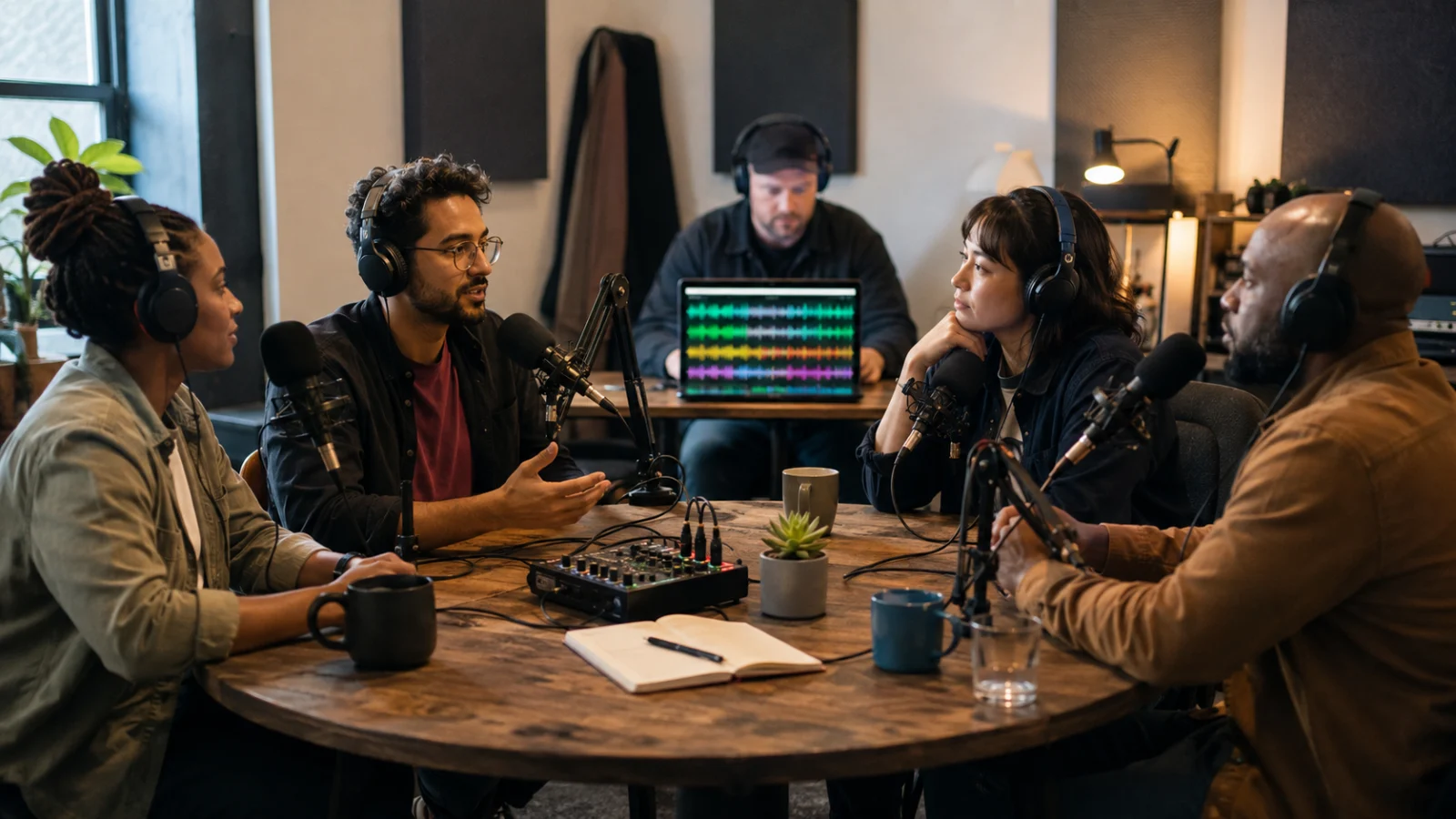
A five-person customer roundtable can become a strong product video, podcast recap, or training module. It can also become an editorial trap. The recording contains useful ideas, but people interrupt one another, the host uses first names only once, two guests sound similar, and one participant agreed to be quoted but not to have their voice synthesized. A plain speech-to-text transcript gives you words. Production needs a trustworthy answer to a harder question: who said each word, and what are you allowed to do with that person's contribution?
That is where speaker diarization becomes operationally useful. Muse Voice Transcribe can produce a streaming transcript with speaker-turn labels. Those labels can help an editor recover the structure of a conversation before deciding which passages to preserve, recast, rewrite, or remove. But “Speaker A” is not a verified identity, a casting instruction, or permission to make a synthetic voice. It is evidence for a production decision—not the decision itself.
This Fine Voice field note presents a complete handoff: start with diarized speech to text, verify a consent-aware speaker map, convert the conversation into renderable script units, cast each approved role in Fine Voice, and review the rebuilt scene as a whole. It does not assume that Fine Voice currently integrates Meta's API. The two products occupy different stages of the workflow described here.
What Muse Voice Transcribe changes for multi-speaker work
Meta introduced Muse Voice Transcribe on September 1, 2026 as a real-time audio perception model in its Muse family. The important word for this workflow is not merely “transcribe.” Meta describes one model handling three related tasks:
- Automatic speech recognition turns speech into words.
- Speaker diarization marks where turns begin and attributes them to recurring speaker labels.
- Endpointing detects when speech begins and when an utterance has ended, which helps a live system decide when a turn is complete.
In Meta's technical explanation, incoming audio is processed in 80-millisecond chunks. Each chunk becomes a soft audio token. The model can emit a control token that effectively means “keep listening,” or it can begin generating text. Reinforcement learning balances transcription accuracy against the delay before the transcript becomes final. This matters in a live meeting or studio feed because waiting for more context may improve a word or a speaker assignment, while waiting too long makes the interface feel unresponsive.
For diarization, Muse Voice Transcribe uses turn and speaker tokens. A start-of-turn marker says a new utterance has begun, while labels such as Speaker A or Speaker B associate turns with speakers already encountered in the stream. Meta says the model can handle more than 20 speakers and maintain context beyond an hour. It was trained across more than 70 languages, with 25 languages extensively verified at launch, and supports features such as code-switching, language or keyword biasing, and contextual hints.
Those capabilities make a diarized transcript much more useful than a single wall of text. An editor can see that one person framed the problem, another challenged it, and a third supplied the example that should become the opening scene. Turn boundaries also provide a natural first pass for splitting a recording into script units. Still, the output remains a machine-generated account of the session. Meta's own demo warns that AI transcripts can be inaccurate. Treat it as a high-leverage draft that stays connected to the audio.
What the benchmark numbers do—and do not—promise
At launch, Meta reported a 3.1% word error rate for final streaming transcription in its comparison chart. Its diarization chart reported a 17.5% average diarization error rate across AMI-IHM, AMI-SDM, and VoxConverse, compared with 21.1% to 28.6% for the other systems shown. Meta also said Muse Voice Transcribe ranked first on the Artificial Analysis streaming speech-to-text leaderboard and on public diarization benchmarks as of September 1, 2026.
These are useful launch measurements, not a warranty for your recording. Word error rate and diarization error rate measure different failures. A transcript can spell nearly every word correctly while assigning a sentence to the wrong person. Conversely, the turns can be separated correctly while a brand name, accent, or specialist term is transcribed badly. Meeting-room distance, reverberation, overlapping speech, microphone quality, language mix, and the number and similarity of voices all change the practical difficulty.
The production question is therefore not “Is the benchmark good?” It is “What does this particular source recording require us to verify before we act on it?” For a casual internal summary, a mistaken label may be an inconvenience. For a customer quote, a compliance training line, or a cloned-voice request, the same mistake can misattribute a claim or attach the wrong person's consent to a synthetic performance. Higher-stakes transformations require stronger review.
A diarized transcript is not yet a speaker map
Suppose the transcript begins like this:
Speaker A: What surprised us was how quickly the team adopted it.
Speaker B: After we changed the onboarding, yes.
Speaker A: Right, but Priya's tutorial did most of the work.
Speaker C: I would not say most of it.
The labels tell you that Speaker A returned after Speaker B. They do not prove that Speaker A is Alex, that Speaker C is Priya, or that any of them agreed to a synthetic reconstruction. Labels are session-scoped placeholders. They should not be treated as biometric identities, and a label from one recording should not automatically be equated with the same letter in another.
The useful next artifact is a speaker map: a record that joins transcript evidence to verified production facts. The independent Muse Voice guide to Muse Voice Transcribe is a useful orientation point for the model and its workflow context. Importantly, musevoice.pro states that its browser product is independent from Meta and currently uses existing transcription providers rather than the Meta Model API. In other words, a workflow can discuss or evaluate Muse Voice Transcribe without pretending every tool in the chain runs that model.
A speaker map should remain separate from the script. The transcript says what the model heard. The map says what the production team verified and approved. Keeping them separate makes corrections auditable: if Speaker B is later confirmed to be Morgan rather than Sam, you update one controlled record instead of silently changing dozens of script fragments.
Build a consent-aware speaker map before choosing voices
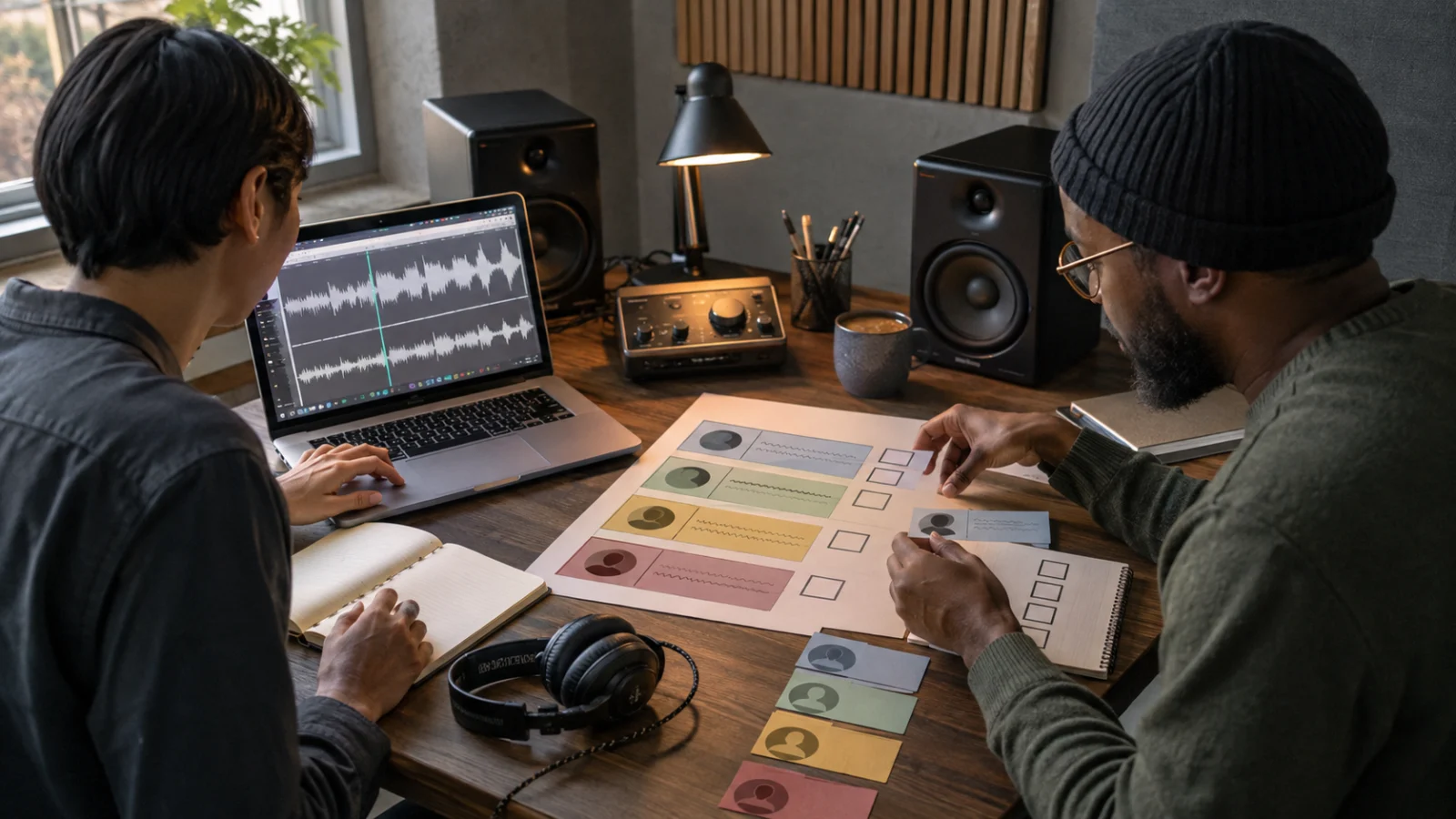
Create one row per real participant, not merely one row per diarization label. At minimum, capture these fields:
| Field | What to record | Why production needs it |
|---|---|---|
| Source label | Speaker A, B, C, or other emitted label | Preserves the link to the machine transcript |
| Confirmed identity | Name or an approved anonymized identity | Prevents a label from becoming an unsupported identity claim |
| Production role | Host, customer, expert, narrator, caller | Guides casting and delivery without imitating the person |
| Verified time ranges | Representative and disputed timestamps | Makes checking the audio fast and repeatable |
| Language notes | Language changes, names, terms, pronunciation | Reduces avoidable recognition and rendering errors |
| Intended transformation | Preserve, edit, clone, recast, summarize, or exclude | Makes the planned use explicit |
| Permission status | Cleared, limited, pending, declined, or unknown | Stops unauthorized work before generation |
| Fine Voice selection | Approved private model or catalog voice | Connects the editorial role to the rendering plan |
| Review owner | Person accountable for identity and final approval | Avoids “someone else checked it” ambiguity |
Permission needs more detail than a green tick. A practical vocabulary is:
- Cleared to reuse original audio: the team may edit and publish the recorded voice within a named scope.
- Cleared to clone within scope: the speaker explicitly approved a reusable synthetic voice and the intended uses, review process, and time window are recorded.
- Recast only: the contribution may be adapted, but the original speaker's identity or vocal likeness must not be reproduced.
- Exclude or redact: the words, identity, or both must not appear in the production.
- Pending: no downstream voice work begins until the open question is resolved.
Access to a file is not permission to clone a person. Nor does permission to quote a customer automatically include permission to generate new lines in their likeness. If the intended use changes—from an internal recap to a public advertisement, for example—return to the speaker and update the scope before producing it.
Step 1: verify every label against the recording
Begin with the easiest evidence. Listen for the host's introduction, direct forms of address, references to roles, and stretches where only one known microphone is active. Mark at least two clean time ranges for each person. Then inspect transitions, because diarization errors often become most consequential at boundaries: interruptions, laughter, short acknowledgements, and one speaker completing another's sentence.
Use a simple three-pass review:
- Anchor the obvious speakers. Confirm the host and anyone who introduces themselves. Record evidence, not just confidence.
- Review every label change. Listen a few seconds before and after the timestamp. Merge labels that belong to one person and split labels that combine two people.
- Flag ambiguity instead of guessing. “Speaker C or D, 18:42–18:49” is safer than a confident but unsupported identity. Exclude or recast the disputed passage until it is resolved.
If you need a browser-based review surface, the Muse Voice speech-to-text workspace supports audio or video upload, browser recording, and media-URL import, then exposes timestamped text, optional speaker separation, editable speaker names, search, replay, and exports including TXT, DOCX, PDF, SRT, VTT, and JSON. That product currently relies on its own listed transcription providers; using it is not a test or invocation of Meta's Muse Voice Transcribe model. The value here is the review pattern: keep labels, timecodes, and audio together while a human verifies the map.
Do not erase the original output after corrections. Preserve a source transcript and create a reviewed version, ideally with a short change log. If a producer merges Speakers D and E, the reason should be visible: same microphone, continuous thought, and confirmation from the session owner. This distinction is especially useful when someone later asks why a quote was assigned to a particular participant.
Step 2: choose preserve, clone, recast, or exclude
Once identity and scope are reliable, choose a treatment for each role. The most faithful treatment is not automatically the safest, and synthesis is not automatically better than a good original take.
| Treatment | Use it when | Production rule |
|---|---|---|
| Preserve original | Performance and recording quality work, and reuse is cleared | Edit lightly and retain the speaker's real context |
| Clone the voice | Vocal identity is essential and explicit cloning permission is documented | Create a private model only inside the approved scope |
| Recast the role | The idea may be adapted but likeness is unnecessary or not permitted | Choose a voice by role, not resemblance |
| Exclude or summarize | Identity, rights, accuracy, or sensitivity is unresolved | Remove the passage or paraphrase without attributing it |
For an approved identity-led role, Fine Voice voice cloning provides the downstream workspace for creating a private model from a permitted reference. Keep the consent record beside the project, define what scripts and channels are allowed, and set an expiry or review trigger. Do not clone a participant merely because the diarized recording contains enough clean speech to make it technically possible.
For recast roles, browse the Fine Voice voice catalog and listen for intelligibility, age range, energy, pacing, and contrast with the other speakers. The goal is not to find “the closest voice to Speaker B.” The goal is to cast a clearly differentiated performance for the editorial role: skeptical buyer, calm moderator, technical specialist, or energetic customer. That preserves conversational structure without manufacturing an imitation.
Exclusion is a valid production decision. If consent is missing, a personal anecdote is too sensitive, or an identity cannot be verified, remove the passage. A slightly shorter scene with a defensible provenance is better than a polished scene nobody can safely approve.
Step 3: turn conversation into renderable script units
Diarization gives you turns, but raw turns are rarely ready for text to speech. Spoken conversation contains false starts, fillers, unfinished references, and answers that make sense only because of a gesture or an earlier question. Clean them without changing the speaker's meaning.
Build each renderable unit with five elements:
- Role and source: the verified speaker-map row and source timestamps.
- Final line: the approved wording to render.
- Context cue: what the preceding speaker just said and what this line is doing in response.
- Direction: pace, energy, emphasis, pause, and emotional restraint.
- Pronunciation notes: names, product terms, numbers, acronyms, and language switches.
Keep most units to one thought. A forty-second monologue is hard to redirect when only one clause sounds wrong; four coherent units are easier to regenerate and recombine. At the same time, do not slice every sentence into isolation. A synthetic answer needs enough context to sound like a response rather than four unrelated announcements.
For example, a diarized line might read: “Yeah, no, after—after the second week, that's when support volume really came down.” The production script might become: “After the second week, support volume really came down.” The speaker map preserves the original timestamp and identity; the script notes that the delivery should feel like a measured correction, not a triumphant claim. If the stutter conveys uncertainty that matters to the story, keep it. Editing is an editorial judgment, not automatic cleanup.
When code-switching appears, verify both the transcription and the intended voice support before rendering. Meta says Muse Voice Transcribe can handle code-switching, but that does not guarantee every proper noun or switch in your audio is correct. Preserve an audio reference for unusual pronunciations, and test a short line in the Fine Voice text-to-speech studio before generating an entire scene.
Step 4: direct each Fine Voice take as a role, not a label
“Speaker A” is not useful voice direction. A compact role brief is. For every selected Fine Voice voice, write a one-line brief such as: “Experienced operations lead; deliberate pace; warm but unsentimental; slight lift when explaining the result.” Then add line-level direction only when the scene requires it.
Cast for separation as well as individual quality. Four pleasant voices with similar pitch, tempo, and energy can be difficult to follow. A listener should recognize a turn change even without seeing a name card. Contrast may come from cadence, vocal weight, age impression, accent, or energy, but it should never turn a real participant into a caricature. If the original speakers are identifiable people and the roles are recast, the production should not invite listeners to infer that the synthetic voices are those people's actual voices.
Generate short drafts first. Review the opening, a high-emotion line, a sentence with names or numbers, and a transition into another speaker. These samples reveal whether the voice fits the role before credits and review time are spent on a full script. Save approved variants with useful names—role, scene, line number, and take—then use Generation History to return to prior renders without confusing them with the latest approved cut.
When cloning has been explicitly approved, direct the clone with the same discipline. Permission to use a person's vocal identity does not mean every possible delivery represents them fairly. Stay within the agreed register and subject matter. A calm expert's clone should not be pushed into anger, panic, flirtation, or endorsement unless those modes were specifically discussed and approved.
Step 5: rebuild the scene and review it in context
Individual takes can sound excellent and still fail as a conversation. Assemble the scene in order, restore intentional pauses, and compare its rhythm with the source. If the host asks a direct question, the reply should not arrive after a documentary-style pause unless that pause serves the story. If two guests originally overlap, decide whether the overlap communicates energy or merely hurts clarity.
Review on three layers:
- Attribution review: Does every rendered line trace to the correct speaker-map row and approved treatment?
- Performance review: Does each voice fit its role, remain distinct, pronounce key terms correctly, and respond plausibly to the preceding line?
- Rights and meaning review: Is the wording faithful to the approved source or adaptation, and is every use inside its consent scope?
Then listen without looking at the script. Visual labels can hide weak differentiation because the editor already knows who is supposed to be speaking. A blind listen reveals whether turn changes are audible, whether one voice dominates, and whether edits create unnatural breaths or silence. Check headphones, laptop speakers, and a phone, because conversational clarity can collapse on small speakers even when a studio monitor mix feels spacious.
As an additional quality check, transcribe the finished mix and compare it with the approved script. This catches dropped words, unexpected pronunciations, and places where background music masks a consonant. It does not replace listening or approval, and a second transcript should not be used to retroactively “prove” identity. It is simply a final text-versus-audio comparison.
Where Muse Voice Transcribe fits—and where it does not
The official Muse Voice Transcribe model page lists Meta Model API access at $0.18 per audio hour. Meta's launch post also names Meta AI for Mac and Muse Code as access points. Availability, pricing, and benchmark positions can change, so check those primary pages before planning a production budget or system architecture.
In this workflow, Muse Voice Transcribe is an upstream listening and structure tool: it turns incoming audio into time-aware words, speaker turns, and endpoints. Fine Voice is a downstream production tool: it helps an editor cast approved voices, create permitted private models, render script units, compare takes, and export audio. Fine Voice does not currently claim a built-in Meta Model API integration. A team using Meta's model would need to pass reviewed transcript information into its production process deliberately.
That boundary is healthy. Transcription confidence is not production permission, and speaker attribution is not voice casting. A clean handoff between systems creates a moment to verify identity, document consent, and decide whether the original voice should be preserved, cloned, recast, or omitted.
Failure modes that matter in production
The workflow is designed around a handful of predictable failures:
- A label swap becomes a false quote. Verify turns at boundaries and trace every published line to source audio.
- Two labels belong to one person. Merge only after listening across multiple clean ranges; keep the change logged.
- One label hides two people. Split the row and hold both passages until their identities and permissions are confirmed.
- Overlap disappears from the transcript. Listen to crosstalk rather than assuming a single emitted line captures both contributions.
- File access is mistaken for consent. Record voice reuse and voice cloning as separate permissions.
- Recasting becomes imitation. Cast the editorial role for clarity and contrast, not to approximate a real participant who did not approve likeness use.
- A correct sentence loses its context. Keep question-and-answer pairs together and document material rewrites.
- Code-switched names or terms drift. Preserve source clips and add pronunciation notes before rendering batches.
- Benchmarks replace source review. Treat published WER and diarization scores as comparative evidence, never as accuracy for your specific recording.
- The final scene is reviewed only line by line. Listen to the complete exchange for rhythm, hierarchy, and unintended implications.
The common thread is traceability. Every production asset should answer: where did this line come from, who was it attributed to, what transformation was approved, which voice rendered it, and who signed off?
A practical handoff checklist
Before a producer begins generating voices, the project should be able to pass this checklist:
- The source audio and untouched diarized transcript are retained.
- Each recurring speaker label is mapped to a confirmed identity or marked unresolved.
- Ambiguous turns, overlap, and suspected label changes have timestamps.
- Quote permission, original-audio reuse, and cloning permission are recorded separately.
- Every participant has an explicit treatment: preserve, clone, recast, summarize, or exclude.
- Private voice models are used only for speakers who explicitly approved cloning within the planned scope.
- Recast voices are selected for role fit and listener differentiation, not unauthorized imitation.
- Script units keep source timestamps, context cues, direction, and pronunciation notes.
- The assembled scene has passed attribution, performance, and rights reviews.
- A named owner is responsible for final approval and for retiring any time-limited private model.
If any item is unknown, stop at that boundary. You can continue preparing unrelated cleared roles while the question is resolved; you do not need to force the whole project through a single uncertain speaker.
Frequently asked questions
What is the difference between transcription and speaker diarization?
Transcription estimates which words were spoken. Speaker diarization estimates when different people took turns and assigns recurring labels to those turns. A transcript can have accurate words but incorrect speaker attribution, so production teams must review both.
Does a Muse Voice Transcribe speaker label identify a real person?
No. A label such as Speaker A is a session-level attribution generated from the audio, not a verified identity or a biometric identity claim. Connect it to a name only after checking the recording and reliable session evidence.
Can I clone every voice separated by diarization?
No. Technical separation does not grant permission. Clone a voice only when that person has explicitly approved creating and using a synthetic version of their vocal identity for the documented project scope.
Does Fine Voice currently integrate the Meta Model API?
This article does not claim a built-in integration. It describes a deliberate handoff in which Muse Voice Transcribe can structure source audio upstream and Fine Voice can handle approved multi-voice production downstream.
How should I handle a diarization label I cannot verify?
Mark it unresolved, retain the relevant timestamps, and do not attach a real identity or cloning permission to it. Exclude, anonymize, or recast the passage until a responsible reviewer can verify the source.
What should be reviewed after the voices are generated?
Check source attribution, role fit, pronunciation, timing, turn differentiation, meaning, and consent scope. Then listen to the complete scene without reading the script and compare a final transcript with the approved text.
From “Speaker A” to an approved voice asset
The value of diarization is not the colored label itself. It is the structure the label gives an editor: a place to verify identity, recover conversational roles, and make a conscious production decision for every voice. When that structure is paired with a consent-aware speaker map, multi-voice production becomes easier to review and much harder to misuse.
Start with one representative scene, not the entire archive. Verify its speakers, record the allowed treatment for each person, and create a small set of renderable lines. Then use Fine Voice text to speech for recast roles or an explicitly approved private model, assemble the scene, and listen for both truth and flow. The result is more than a polished transcript: it is a traceable, reviewable path from a real conversation to a responsible multi-voice production.